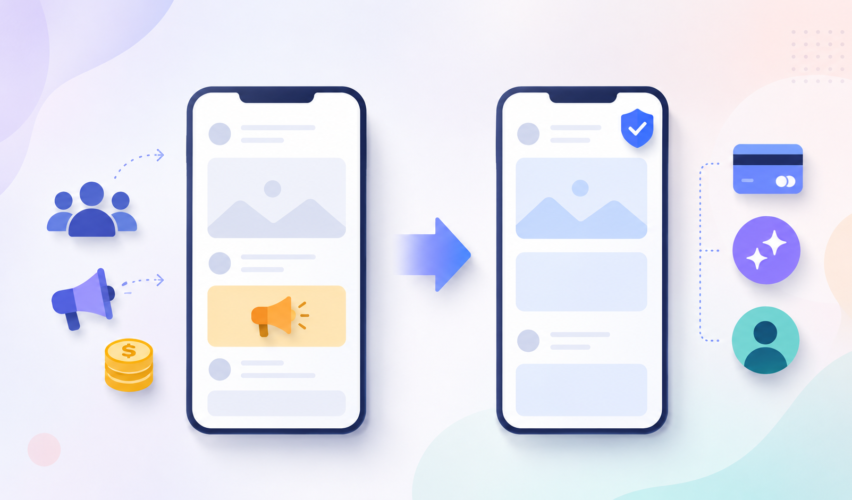
For two decades, the deal at the heart of social media was simple and unspoken. You got the service for free, and in exchange you became the product, your attention packaged and sold to advertisers. That bargain built some of the largest companies in history. But it is now visibly cracking, and the platforms are scrambling to replace it. The new answer, increasingly, is to ask users to simply pay. Subscriptions, premium tiers, paid verification, and ad-free upgrades are spreading across every major network, and together they represent the most significant change to social media’s business model since its founding. Understanding why this is happening, and where it leads, matters to anyone who uses these apps.
Why the advertising model started to wobble
The advertising engine did not break overnight, but several forces converged to weaken it. Privacy changes at the operating-system level made it harder to track users across apps, which is precisely how targeted advertising justified its premium prices. When platforms can no longer follow a user from one app to the next, the ads they show become less precisely aimed and therefore less valuable. At the same time, a flood of automated and AI-generated content has degraded the quality of feeds, and regulators in many regions have grown more hostile to surveillance-based advertising.
There is also a simpler problem of saturation. There are only so many ads a person will tolerate in a feed before the experience becomes unpleasant, and most major platforms are already close to that ceiling. Growth in users is slowing in mature markets, so squeezing more advertising revenue out of the same audience has diminishing returns. Faced with all this, the platforms began looking for a revenue stream that does not depend on tracking, does not clutter the feed, and grows even when the audience does not: getting users to pay directly.
The verification experiments that opened the door
The first widely noticed move in this direction was paid verification. When X, formerly Twitter, restructured its blue checkmark into a paid subscription, the rollout was chaotic and widely mocked. Yet beneath the controversy, something important was being tested: would ordinary users pay a monthly fee for status, visibility, and extra features on a platform they had always used for free?
The answer, it turned out, was yes, at least for a meaningful minority. X Premium evolved from that messy launch into a structural pillar of the platform’s economics, growing into multiple tiers with millions of paying subscribers and well over a billion dollars in annualized subscription revenue. No other major network derives so much of its income directly from users rather than advertisers. The lesson was not lost on competitors. Soon after, the largest social company launched its own verification subscription, aimed initially at creators and businesses, bundling a verified badge with impersonation protection, direct support, and added visibility. By some estimates this verification product alone attracted tens of millions of sign-ups and billions in new annual revenue.
From verification to a full premium tier
Verification was only the opening act. The more recent and more consequential shift is the move toward broad premium subscriptions aimed at everyone, not just creators. The clearest signal came when the largest social-media company confirmed it would test premium tiers across all three of its flagship apps, unlocking exclusive features while keeping the core apps free.
Crucially, these new subscriptions are separate from verification and are designed for a much wider audience. The features vary by app and reveal exactly what the platforms believe people will pay for. On the photo-and-video app, the premium tier centers on public signaling and analytics: new ways to organize followers, the ability to see who has rewatched your stories, previewing your own stories without registering as a viewer, and posting without appearing in the feed. On the messaging app, the focus is aesthetic and personal: custom chat themes, custom ringtones, and premium stickers. The pattern is deliberate. Rather than one universal bundle, each app gets its own set of perks tuned to how people actually use it.
Snapchat proved people will pay
If the verification experiments cracked the door open, one company’s quieter success pushed it wide. Snapchat’s premium subscription demonstrated, well before the giants fully committed, that there was real and durable demand for paid social features. Starting at a low monthly price and offering exclusive extras that enhance the core experience without degrading the free version, it grew steadily into one of the platform’s reliable revenue drivers, eventually surpassing sixteen million subscribers and more than doubling its base in a couple of years.
That trajectory mattered enormously, because it answered the central skeptical question. The doubt was never whether platforms wanted subscription money; it was whether users habituated to free social media would actually pay. Snapchat showed they would, provided the paid features felt like genuine enhancements rather than a tax on functionality that used to be free.
The AI wildcard
The next phase, and possibly the most lucrative, is artificial intelligence. The platforms are racing to embed AI assistants, image and video generation, and other compute-heavy features into their apps, and these tools are extraordinarily expensive to run. Advertising does not obviously cover that cost. Subscriptions do.
Several companies have signaled that their most advanced AI capabilities will sit behind a paywall, mirroring a broader industry pattern in which premium AI features become a primary reason to subscribe. This reframes the whole strategy. The pitch is no longer just “pay to remove ads” or “pay for a badge,” but “pay for powerful tools you cannot get for free.” If that proves compelling, AI could become the feature that finally makes social subscriptions mainstream rather than niche.
The obstacles standing in the way
None of this is guaranteed to work, and the platforms know it. The biggest threat is subscription fatigue. People already pay monthly for streaming video, music, cloud storage, and more, and there is a real limit to how many recurring charges anyone will accept. Convincing someone to add yet another to the pile requires offering something genuinely valuable, not merely repackaging existing features behind a paywall.
There is also a deep cultural expectation to overcome. Social media has been free for so long that charging for it feels, to many users, like a broken promise. The platforms are navigating this carefully by keeping core functionality free and positioning paid tiers as optional enhancements. So far, none of the major companies even breaks out subscription revenue separately in its annual reporting, an implicit admission that, for most of them, uptake remains a minority pursuit rather than the main event.
What it means for the future of the feed
Taken together, these moves point toward a more layered social internet. The likely future is not the end of free social media but a tiered version of it, where a free, ad-supported experience coexists with paid tiers that determine personalization, performance, and access to the best new tools. The user who pays gets a cleaner, more powerful, more private experience; the user who does not still gets the core service, funded by ads.
This is a meaningful philosophical shift. For twenty years the relationship between platform and user was mediated entirely by advertisers. Now the platforms are trying to build a direct financial relationship with the people who use them. Whether that produces a healthier internet or simply a two-class one, where privacy and quality become things you buy, is the open question. What is no longer in doubt is the direction. The era in which social media’s only product was your attention is quietly drawing to a close.