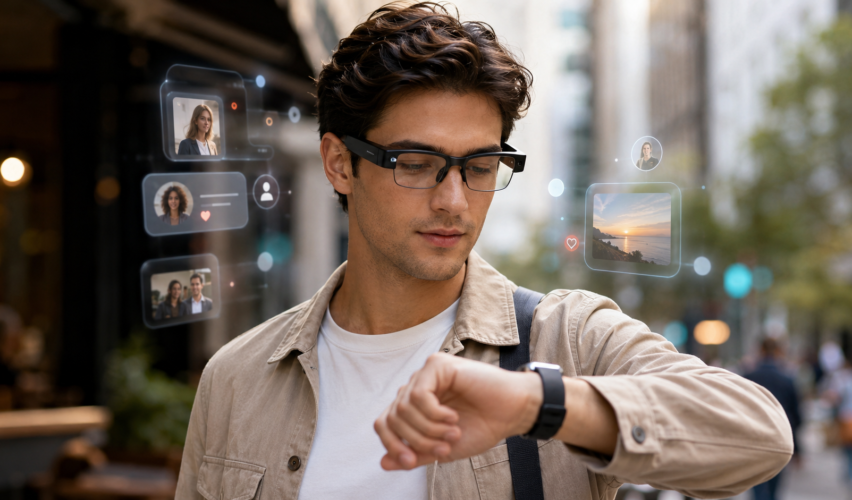
The smartphone has been the undisputed home of social media for nearly two decades, but a quieter shift is happening a little further down the arm. Smartwatches, fitness bands, and now smart glasses are steadily absorbing more of the social experience, turning a glance at your wrist or a tap on the temple of your glasses into a way to stay connected. This is not a fringe phenomenon. Smartwatches alone are now worn by close to a third of the population in major markets, which means social platforms can no longer treat the wrist as an afterthought. The integration of social media with wearables is becoming one of the more consequential frontiers in how we communicate.
For most people, the relationship began modestly, with notifications. The earliest and still most common social feature on a smartwatch is the simple alert: a buzz on the wrist telling you someone liked your post, sent you a message, or tagged you in a photo. This sounds trivial, but it changed behavior in a meaningful way. A notification on a phone requires you to pull the device from a pocket, unlock it, and risk falling into the endless scroll. A notification on the wrist is glanceable. You can see who messaged you, decide whether it matters, and dismiss it without ever opening the floodgates. In that sense, the watch initially served as a filter, a way to stay reachable without being consumed.
But the wearable’s role has been expanding well beyond passive alerts. Messaging is where the integration has matured fastest, because short, quick communication suits a small screen perfectly. Major messaging apps now let users read full conversations, view media, and reply directly from the wrist, whether by voice dictation, quick canned responses, or tiny keyboards. One widely used messaging platform recently returned to Android’s wearable operating system with a dedicated watch app, letting people browse chats, read longer messages, and even record and listen to voice notes without touching their phone. Voice notes in particular feel native to the form factor; speaking into your wrist to fire off a reply is genuinely faster than typing, and it fits the on-the-go moments when a watch is most useful.
Then there is the social dimension of health and fitness data, which is arguably where wearables have created entirely new kinds of sharing. Fitness bands and smartwatches track steps, workouts, heart rate, and sleep, and platforms have built social layers on top of this data. Sharing a completed run, competing on a leaderboard, sending an encouragement to a friend who closed their activity rings, or posting a workout summary to a feed are all forms of social interaction that simply did not exist before the wearable generated the underlying data. This blends social media with self-tracking in a way that can be motivating, turning private health metrics into a shared, communal experience.
The most ambitious frontier, however, is no longer the wrist at all but the face. Smart glasses have rapidly become the device that platform makers are betting on most heavily. The leading consumer smart glasses already let wearers capture photos and video hands-free and send voice messages through messaging apps without ever reaching for a phone. More recent display-equipped versions have gone further, adding the ability to share directly to social platforms, including posting short-form video straight from the glasses, along with customizable widgets and screen recording for capturing augmented-reality moments. The appeal is obvious and slightly unsettling at once: the camera is already pointed where you are looking, so the friction between experiencing a moment and broadcasting it nearly vanishes.
What ties all of this together is a strategic vision that goes beyond convenience. The largest social-media company has made clear that it sees wearables, not the phone, as its path to becoming a hardware platform in its own right. Lacking a smartphone of its own, it is building an ecosystem in which glasses provide the eyes and ears, a wrist device provides input and health tracking, and an AI assistant ties them together so that the assistant is always available without anyone having to hold a screen. A reported wrist device, revived after an earlier cancellation, is designed to pair tightly with the company’s glasses and its social platforms, positioning the watch as a control hub and a more constant entry point to its services than any app could be. Competitors are pursuing similar bundles of glasses, watches, and AI, signaling that the whole industry expects the next interface for social connection to be worn rather than held.
None of this is without friction. Battery life on the most advanced glasses remains short, often only a handful of hours, which limits all-day use. The form factor imposes real constraints; you cannot meaningfully scroll a feed on a watch face, so wearables work best for quick, targeted interactions rather than deep engagement. And the privacy questions are serious, particularly for camera-equipped glasses that can record the people around you without their knowledge. As these devices fold social features ever closer to the body, the line between being present and being permanently connected grows harder to see.
Still, the direction is unmistakable. The wearable started as a humble notification relay and is steadily becoming a genuine social device, capable of messaging, sharing, and capturing on its own terms. For now, the phone remains the center of gravity, the place where the heavy scrolling and posting happen. But the wrist and the face are quietly taking over the quick, frequent, in-the-moment interactions, and as AI assistants make these devices smarter and more capable, that share will only grow. The future of social media may not be something you pull out of your pocket at all. It may be something you simply wear.